
Choosing between a martingale and a classic leather dog collar isn’t really about which one is objectively better — it’s about which one actually suits your dog’s build, temperament and daily routine. At Nova X Leather, we stock both styles and get asked to compare them constantly, usually by owners of dogs with narrow heads or a habit of backing out of their collar during walks. This guide breaks down exactly how each design works, where each genuinely excels, and the situations where one is clearly the safer or more practical choice, so you can decide with the real trade-offs in mind rather than guessing based on looks alone. We’ll also cover handmade and Hermann Oak leather options in both styles, plus training considerations and how to switch styles as your dog’s needs change over time.
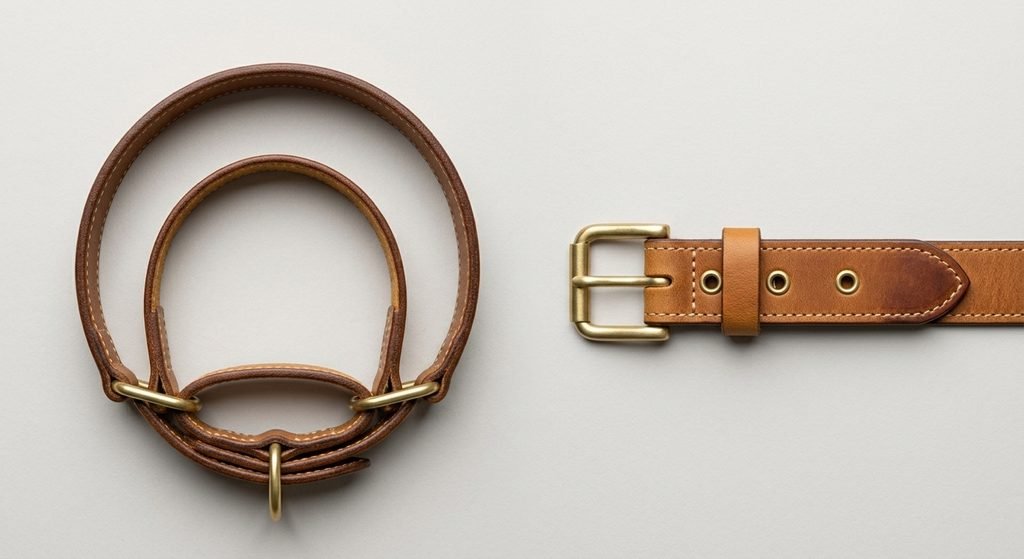
At a glance, the two styles might look similar, but they work on fundamentally different principles. A classic collar is a fixed-circumference loop that stays the same size whether or not your dog is pulling, while a martingale collar is built with a secondary loop that allows the whole collar to tighten slightly under tension before stopping at a controlled limit. That single mechanical difference shapes almost everything else in this comparison, from safety to comfort to which dogs each style actually suits best, and it’s worth keeping that core distinction in mind as we go through the finer details of each.
A classic collar has one strap and one buckle, adjusted once to a fixed size and left alone. A martingale collar has two loops — a larger loop that sits around the neck and a smaller control loop that the leash clips to — so that when a dog pulls backward, the control loop draws the larger loop snugger, without the collar ever closing enough to choke. This tightening action is entirely mechanical and self-limiting, stopping once the loop reaches its designed minimum size.
Classic collars remain the default first purchase for most Australian dog owners simply because they’re the more familiar, widely available option, while martingale collars tend to be a considered second purchase after an owner has experienced a dog slipping out of a classic collar at least once. This pattern is common enough that many pet retailers report martingale sales spiking specifically after adoption of sighthound breeds.
Understanding the mechanics of a martingale leather dog collar in more depth helps explain both why it’s so effective for certain dogs and why it needs a slightly different approach to sizing and daily use than a classic design. This isn’t just an aesthetic difference between the two collar types — it changes how the collar should be measured, fitted and checked over time.
The larger loop sits loosely around the neck in its relaxed state, while the smaller control loop connects both ends of the larger loop to the leash attachment point. When tension is applied, the control loop pulls the two ends of the larger loop closer together, gradually reducing the collar’s circumference until it reaches a pre-set limit. Once that limit is reached, further pulling doesn’t tighten the collar any further, regardless of how hard the dog continues to pull.
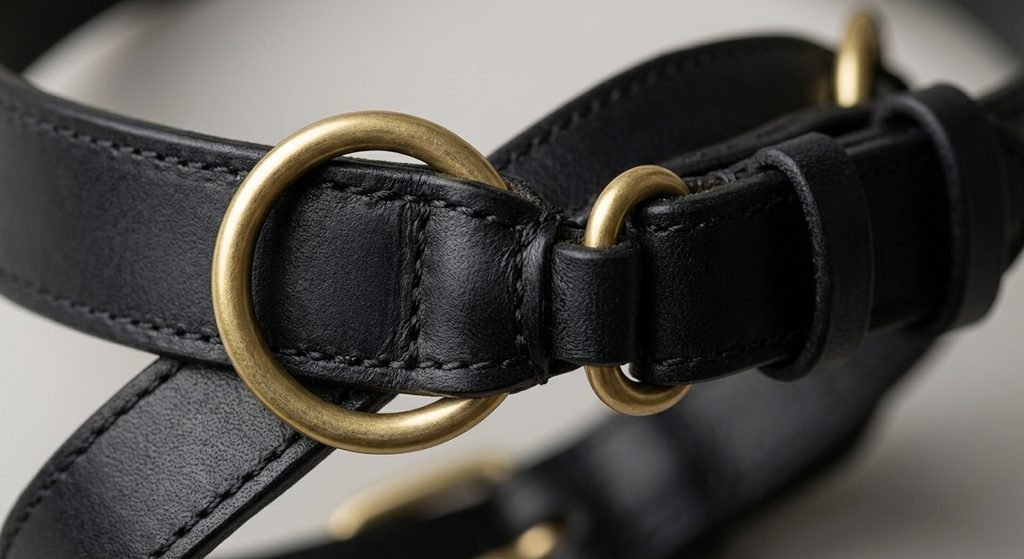
The key word is limited — a properly sized martingale leather dog collar is designed to tighten only enough to prevent the head from slipping through, not to choke or restrict breathing, which is very different from how a choke chain functions and is a distinction worth understanding before dismissing the style outright. This limited action is precisely what makes it a recommended safety tool rather than a training device meant to cause discomfort.
A classic dog collar leather design is mechanically much simpler than a martingale, which is exactly why it remains the standard choice for the vast majority of everyday dog owners and situations. Its simplicity is a genuine feature, not a shortcoming, for dogs that don’t need the added slip protection a martingale provides.
A single leather strap runs through a buckle, fastened at a fixed hole to sit comfortably around the neck, exactly like a traditional belt. The circumference never changes once fastened, regardless of how much a dog pulls against it during a walk, which means the fit relies entirely on getting the initial sizing correct.
Because the design is so simple, a classic collar is easy to fit, easy to repair, and easy for any dog owner to understand at a glance, which is a genuine advantage for anyone who prefers straightforward, low-maintenance equipment. There’s also nothing mechanical to eventually wear out beyond the buckle itself.
For the right dog, the practical safety and control benefits of a martingale leather dog collar are significant enough that many owners never go back to a classic design once they’ve made the switch. These benefits become especially clear the first time a dog that previously slipped its collar simply can’t anymore.
Breeds with necks wider than their heads — Greyhounds, Whippets and similar sighthounds are the classic example — can often back straight out of a classic collar sized to fit comfortably. A martingale’s tightening action specifically prevents this, making it the safer standard recommendation for these breeds, and it’s genuinely rare to see an experienced sighthound owner using anything else.
Because the tightening is gradual and limited rather than sudden, a martingale leather dog collar also provides gentler feedback during leash training than a choke chain, discouraging pulling without the harsh, sudden correction a choke-style collar delivers. Many trainers see this as a genuine welfare improvement over older-style correction tools.
Despite the safety benefits of a martingale, a huge number of leather dog collar Australia buyers still choose classic collars, and for very sensible reasons that shouldn’t be overlooked. For dogs without any slipping risk, a martingale simply adds complexity without a corresponding benefit.
For dogs without a slipping risk, a classic collar sits at a constant, predictable circumference all day, which many owners and dogs simply find more comfortable for everyday wear than a design that changes shape under any tension. This consistency is part of why classic collars remain the default choice for all-day, everyday wear.
A classic collar’s fixed D-ring position makes it simple to attach ID tags, bells or other accessories that hang consistently in the same spot, whereas a martingale’s moving loops can shift tag position slightly depending on tension. For dogs that wear their collar primarily for identification, this consistency is a small but genuine practical advantage.
Neither style is without trade-offs, and being upfront about the downsides of each is more useful than pretending one option is perfect for every dog and situation. Knowing these limitations in advance helps set realistic expectations before you buy.
A martingale needs slightly more careful sizing than a classic collar, since it must be measured against both neck and head circumference, and an incorrectly sized martingale can either fail to tighten enough or tighten too much, undermining the safety benefit it’s designed to provide. Taking the time to size correctly at purchase is essential, not optional, with this style.
For a dog genuinely prone to backing out of a collar, no amount of careful classic-collar sizing fully solves the underlying problem the way a martingale’s tightening mechanism does, which is the main reason vets and trainers specifically recommend martingales for these cases rather than simply advising a tighter fit on a classic collar.
Collar style aside, the quality of a handmade leather dog collar still comes down to the same fundamentals of leather selection, stitching and hardware, regardless of whether it’s built as a martingale or a classic design. It’s worth judging craftsmanship and style choice as two separate questions rather than assuming one guarantees the other.
Building a martingale requires more precise construction than a classic collar, since the two loops and their connecting hardware all need to move smoothly together, so a well-made handmade leather dog collar in this style needs careful attention to how the loops interact under tension, not just how it looks when static.
A handmade leather dog collar in a classic design puts more craftsmanship focus into edge finishing, stitching and hole placement, since the buckle mechanism itself is relatively simple compared to a martingale’s moving parts.
A Hermann Oak leather dog collar brings the same exceptional durability to either style, though the density of this particular leather has slightly different practical implications depending on which design you choose. Understanding these small differences helps set realistic expectations for how the collar will feel when new.
For large or powerful dogs that pull hard on lead, a Hermann Oak leather dog collar’s density provides genuine reassurance in either a martingale or classic build, resisting stretching and wear far better than lower-grade commercially tanned leather over years of heavy use, particularly at stress points near the buckle or control loop.
Whether built as a martingale or classic collar, a Hermann Oak leather dog collar typically outlasts several generations of lower-grade collars, making the higher upfront cost a reasonable long-term investment for owners who keep their dogs on lead frequently.
Anyone shopping for a leather dog collar Melbourne retailers stock will generally find both martingale and classic styles well represented, though it’s worth knowing what to check for in each before buying. A quick physical check before purchase reveals more about build quality than a product photo ever can.
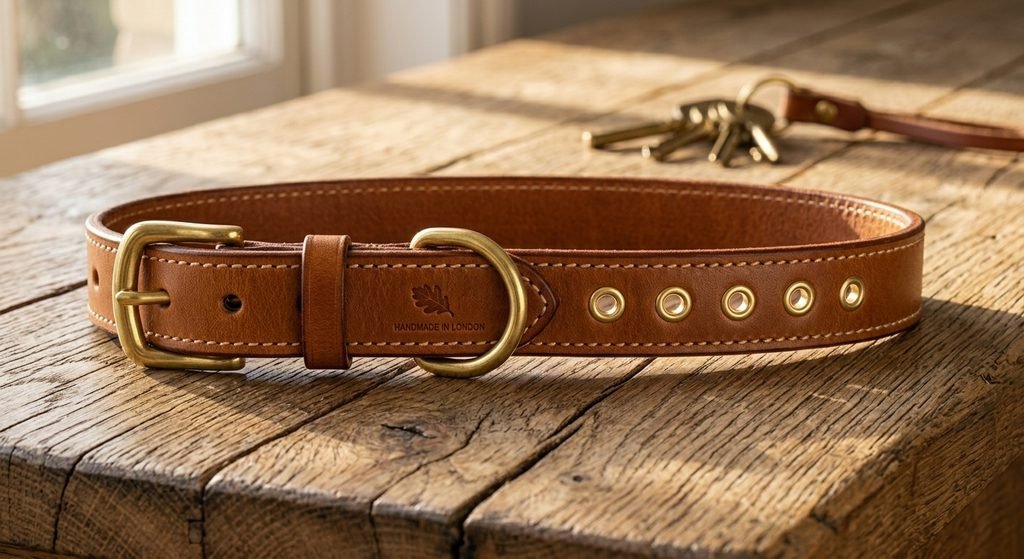
When choosing a martingale leather dog collar Melbourne buyers should check that both loops move smoothly and that the control loop’s chain or leather section is securely stitched, since this connection carries significant load whenever a dog pulls. A stiff or jerky action in-store is a reasonable sign to look elsewhere.
For a classic leather dog collar Melbourne shoppers should check the D-ring attachment is solidly riveted rather than simply looped through the strap, since this is one of the first points to fail under sustained pulling on a lower-quality collar.
Ultimately, the right choice depends less on general opinion and more on your specific dog’s build, behaviour and daily routine, which is worth assessing honestly before deciding. A short mental checklist of your dog’s history and habits is usually enough to point clearly toward one style over the other.
Sighthounds, dogs recovering from recent weight loss, nervous or anxious dogs prone to bolting, and any dog with a documented history of slipping a collar are all strong candidates for a martingale as the safer everyday choice. If in doubt about your own dog’s risk level, a martingale is generally the more cautious default.
Confident, well-trained dogs with no history of backing out of a collar, and situations where a collar is worn mostly for ID and tag purposes rather than active leash walking, are generally well served by the simplicity of a classic design, which remains a perfectly safe and appropriate choice for the majority of dogs.
Some trainers prefer a martingale during leash training specifically for its gentle, self-limiting correction, while others prefer a classic collar paired with a separate front-clip harness for pulling control, so preference varies by training philosophy as much as by dog.
Most dogs adjust to either style within a few walks, though dogs unused to any tightening sensation may need a short adjustment period with a martingale before it feels completely natural on lead.
Martingale collars typically cost slightly more than an equivalent classic collar due to the additional hardware and more complex construction, though the difference is usually modest rather than dramatic across most leather ranges.
Puppies with rapidly changing proportions often do well on an adjustable classic collar during early training, with many owners transitioning to a martingale later if their adult dog’s build or behaviour suggests it’s the safer long-term option.
It’s entirely normal to switch styles as a dog matures — a young, nervous rescue might need a martingale initially and transition to a classic collar once settled, or vice versa if an older dog begins losing weight and becoming prone to slipping out.
No — a correctly sized martingale tightens only to a limited, pre-set point designed purely to prevent slipping, not to choke; the concern usually stems from confusing martingales with choke chains, which work very differently.
If you’re unsure which style suits your dog, borrow or buy an affordable martingale first and observe a few walks before investing in a premium handmade or Hermann Oak version in that style.
There’s no universal winner between a martingale and a classic leather dog collar — the right choice depends entirely on your dog’s build, temperament and how much slipping risk you’re managing day to day. Escape-prone breeds and nervous dogs generally do better in a martingale, while confident, well-fitted dogs are often perfectly served by the simplicity of a classic design. Whichever style suits your dog, choosing a quality handmade leather dog collar or a durable Hermann Oak leather dog collar ensures it holds up to years of daily walks. Browse both styles at Nova X Leather Store and choose the design that actually fits how your dog behaves on lead.