Few accessories work as hard as a good belt, yet most people buy one in about thirty seconds and never think about it again. At Nova X Leather, we see the opposite happen once someone tries a belt that actually fits their waist, their outfit, and their buckle preference — they stop reaching for the cheap ones in the bottom drawer. Getting the width and buckle right isn’t fussy detail for its own sake; it changes how a belt sits, how long it lasts, and how it reads with your outfit, whether you’re in a boardroom in Melbourne or heading out on the weekend. This guide walks through every practical decision — width, buckle mechanism, metal finish, gender-specific fit, local climate care, and body proportion — so the next belt you buy is one you actually reach for every day, not one that ends up forgotten in a drawer after a single wear.
Understanding Leather Belt Width for Different Occasions
Belt width is the single most overlooked measurement in menswear and womenswear alike. A belt that’s too wide for your trouser loops bunches and twists; one that’s too narrow looks lost against a heavier buckle or a thicker waistband. The general rule is that width should scale with formality — narrower for tailored, wider for casual — but Australian wardrobes tend to mix both in the same week, so it pays to own more than one width. Think of belt width the way you’d think about shoe size: a single number that quietly determines whether everything above it looks intentional or accidental, no matter how good the leather or the buckle finish happens to be on its own.
Formal vs Casual Leather Belt Width Choices
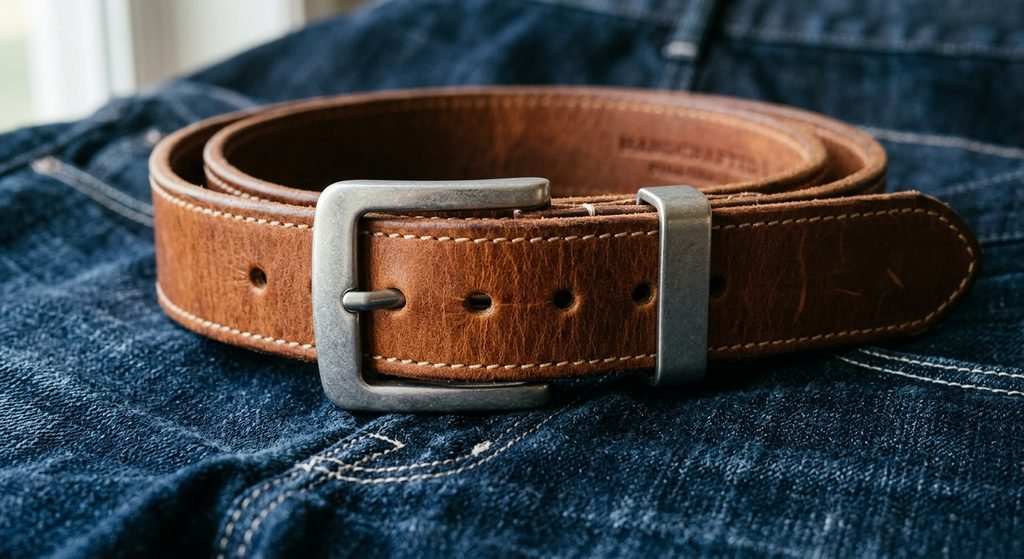
Formal trousers and suit pants are usually cut with narrow loops, around 3cm to 3.2cm, so a slim belt keeps the silhouette clean and avoids the belt fighting the waistband. Casual and workwear-style trousers use wider loops, often 3.8cm to 4cm, built to handle heavier canvas or denim, and a wider belt fills that loop properly instead of leaving gaps at the top and bottom. Mixing these up is the most common fit mistake we see — a slim dress belt threaded through wide denim loops looks thin and flimsy, while a heavy workwear belt crammed through tailored loops distorts the waistband and pulls the trousers out of shape.
Belt Width for Suits, Jeans and Chinos
For suits, stick to 30mm to 32mm in a smooth, low-sheen leather with a minimal buckle. Chinos sit comfortably in the 32mm to 35mm range, giving a bit more presence without looking bulky. Jeans are the most forgiving: anything from 35mm to 40mm works, and this is where a heavier buckle or a ratchet mechanism genuinely earns its place. If your wardrobe leans heavily towards one category, buy for that first — a single well-chosen 35mm belt in a versatile brown will comfortably cover chinos and jeans, while a dedicated 30mm belt handles anything that needs a jacket.
Standard Leather Belt Widths Explained (Mens Leather Belt Guide)
Most mens leather belt ranges are built around four core widths, and once you know them, shopping gets a lot faster. Think of width less as a style choice and more as a sizing decision that happens to also affect style — get it wrong and everything downstream, from buckle proportion to loop fit, is compromised. Once you know your usual width, repeat purchases become far quicker, since you can filter almost any belt range down to the one or two sizes that will actually fit your trousers before you even look at colour or buckle style.
30mm vs 35mm vs 40mm Mens Leather Belt Width
A 30mm belt is the dress standard, pairing naturally with formal buckles and slim trousers. 35mm is the versatile middle ground that works for smart-casual chinos and lighter denim. 40mm is the workwear and rugged-casual width, usually matched with a solid single-prong or ratchet buckle and worn with jeans, boots and heavier fabrics. Some ranges also offer a 25mm option aimed at slimmer builds or fashion-forward tailoring, proving that width isn’t a one-size-fits-all number even within menswear.
How to Measure Your Correct Belt Width
Lay a well-fitting pair of trousers flat and measure the loop opening with a tape measure or ruler — that number, not your waist size, is your belt width. If you’re between sizes, or your wardrobe mixes formal and casual pieces, it’s worth owning one narrow and one wider belt rather than trying to make a single width do every job. If you don’t have a tape measure handy, an existing belt you already know fits well works just as reliably — measure the strap itself rather than guessing from memory, since small differences of even a few millimetres are enough to change how it sits in the loop.
Choosing a Leather Belt Buckle Style: Buckle Guide Basics
A buckle guide really comes down to three mechanisms — pin, ratchet and plate — and each changes how the belt looks, adjusts and lasts. Buckle choice matters just as much as width because it’s the first thing anyone actually notices; the strap is essentially a frame for it.
Pin Buckle vs Ratchet Buckle vs Plate Buckle
A pin buckle is the classic option: simple, reliable, and easy to repair if the leather ever wears out. A ratchet buckle uses a track of small grooves along the strap instead of pre-punched holes, giving finer, half-centimetre adjustment. A plate buckle is a flat metal panel, usually screwed or riveted to the strap, favoured for bold, minimal designs and easy strap swaps. Each mechanism trades off slightly differently between ease of repair, adjustment precision and visual weight, so the right choice usually comes down to how often you expect your waist size to fluctuate and how much hardware you want on show.
Buckle Metal Finishes: Silver, Gunmetal and Brass
Silver-tone buckles are the safest match for most metals you already wear — watch cases, belt loops with metal rivets, cufflinks. Gunmetal and matte black finishes suit darker, more casual leathers and resist showing fingerprints and scuffs. Brass and antique-brass finishes pair beautifully with tan and cognac leather and tend to develop a handsome patina over time rather than looking worn out. If you’re unsure which finish to start with, gunmetal is the most forgiving all-rounder — it works across black, brown and tan leathers without clashing, which makes it a sensible first buckle finish if you’re building out a small rotation of belts.
Mens Leather Belt Width and Buckle Pairing Tips
Width and buckle should be chosen together, not separately, because a buckle that’s proportionally too large or small for the strap looks off no matter how good either piece is on its own. As a general proportion rule, the buckle frame should sit roughly level with the strap edges rather than overhanging them noticeably in either direction, which is where a lot of budget belts fall short even when the leather itself is decent.
Best Buckle Styles for Formal Mens Leather Belts
For formal wear, keep the buckle frame close to the strap width, in a slim, low-profile pin or a discreet plate finish. Polished silver or gunmetal reads as intentional and tidy under a jacket, while anything oversized will visually compete with your tie and jacket buttons.
Best Buckle Styles for Casual Mens Leather Belts
Casual belts can carry more buckle personality — a slightly raised pin buckle, a textured plate, or a ratchet mechanism with a brushed finish. This is where a wider strap and a heavier buckle actually balance each other out instead of looking mismatched.
Ratchet Leather Belt: Width, Buckle and How It Works
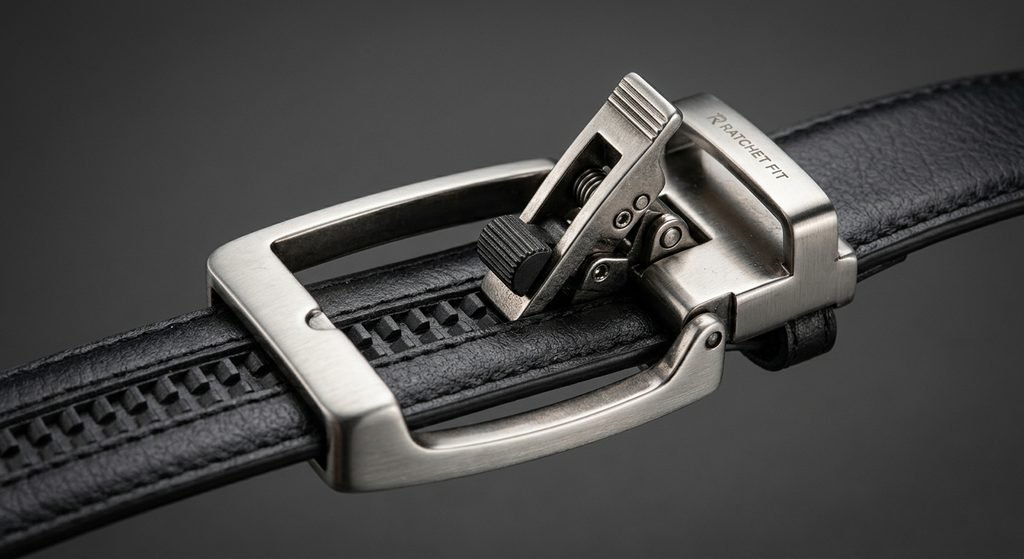
A ratchet leather belt has become one of the most requested styles because it solves the age-old problem of never quite fitting between two holes. Instead of punched holes, the strap has a row of fine grooves that click into a spring-loaded buckle mechanism. It’s a small mechanical upgrade over the traditional pin-and-hole design, but the day-to-day difference in comfort and fit is bigger than most people expect before trying one.
How a Ratchet Leather Belt Mechanism Works
Inside the buckle sits a small spring-loaded latch that catches on the grooves along the strap. To release it, you lift a lever underneath the buckle and slide the strap free — no pulling, tugging or stretching the leather, which also means less wear around any single point of the strap. Because the strap isn’t repeatedly forced through the same punched hole, a well-made ratchet leather belt tends to keep its shape at the adjustment point noticeably longer than a traditional pin-and-hole design worn daily.
Benefits of a Ratchet Leather Belt for Everyday Wear
Because adjustment happens in small increments rather than whole-hole jumps, a ratchet leather belt fits more precisely after a big meal, a workout routine, or simple day-to-day fluctuation. It’s also genuinely fast to put on, which is why so many of our customers switch to one as their daily belt and keep a classic pin buckle style for dress occasions.
Handmade Leather Belt Craftsmanship and Width Considerations
A handmade leather belt is built differently from a mass-produced one, and it shows in the width tolerance, the edge finish and how the leather behaves over years of wear rather than months. The extra time that goes into cutting, edging and stitching by hand doesn’t just affect looks — it directly affects how consistently the strap holds its width and shape after repeated buckling and unbuckling.
What Makes a Handmade Leather Belt Different
Machine-cut belts are stamped from large hides at speed, which is efficient but can miss the natural grain direction. A handmade leather belt is typically cut by hand along the strongest part of the hide, following the grain so the strap resists stretching and cracking at the fold points near the buckle. This attention to grain direction is subtle, but it’s one of the main reasons a handmade leather belt often keeps its shape and width consistent for years, rather than gradually stretching out of proportion the way a poorly cut strap can.
Hand-Stitched Edges and Handmade Leather Belt Quality
Hand-burnished and hand-stitched edges are smoother to the touch and age more gracefully than machine-sealed edges, which can flake or peel after repeated exposure to sun and moisture. It’s a small detail, but it’s usually the first place a lower-quality belt starts to show its age.
Leather Belt for Women: Width and Buckle Differences
A leather belt for women follows the same core principles as menswear, but proportions and buckle scale usually shift to suit narrower loops and a wider range of use — dresses, tailored trousers, denim, even layered over coats. Because a leather belt for women is so often worn as a styling piece rather than purely a functional one, width and buckle choice tend to carry even more visual weight than in menswear.
Leather Belt for Women: Slim Width Styles
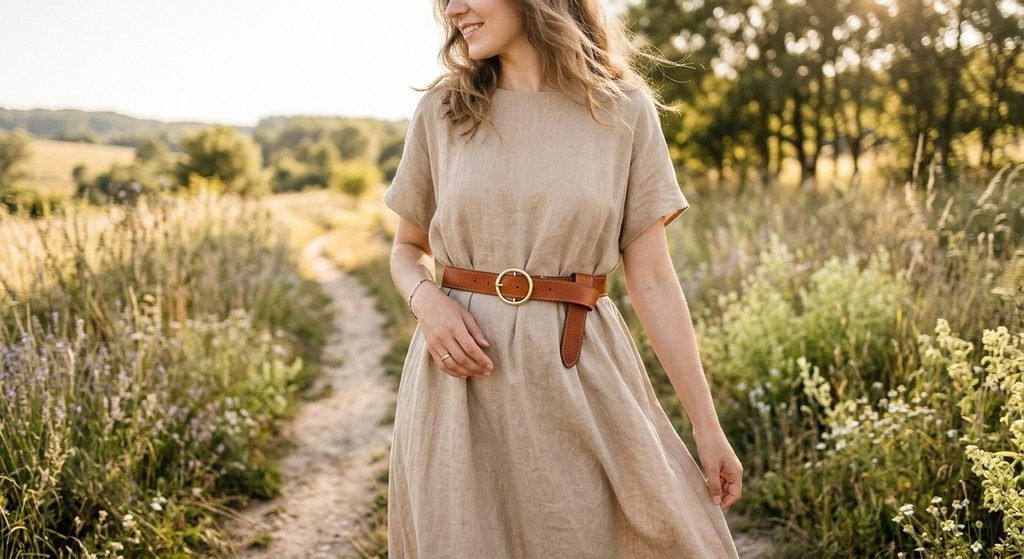
Slim widths between 20mm and 28mm are the most versatile for a leather belt for women, working equally well threaded through trouser loops or cinched over a dress or coat as a statement piece rather than a functional necessity.
Buckle Choices for a Leather Belt for Women
Smaller pin buckles and delicate plate buckles tend to suit slimmer straps best, keeping proportions balanced. For a bolder look, a wider 30mm to 35mm strap with a statement buckle works well as an outerwear accessory, cinching a coat or oversized shirt at the waist. Gold and rose-gold tone buckles are especially popular in this category, since they read as polished and finished without needing to be oversized to make an impression.
Leather Belt Melbourne: Local Buying Guide and Tips
Shoppers searching for a leather belt Melbourne stockists actually stand behind usually want the same thing: a strap that holds up to daily commuting, unpredictable weather, and years of use rather than one season. Melbourne’s famously changeable weather in particular — warm mornings, sudden showers, cool evenings — means a belt gets tested across a wider range of conditions than in most other Australian cities, which makes leather quality and hardware choice even more important.
Where to Buy a Quality Leather Belt Melbourne Shoppers Trust
Look for full-grain or top-grain leather, solid brass or zinc-alloy buckle hardware, and stitching that’s even and tight along the edge. Reading return policies and warranty terms matters too — a maker confident in their construction will usually stand behind it for longer than a generic import.
Leather Belt Melbourne Delivery and Sizing Tips
When buying online rather than trying a belt on in person, always measure an existing well-fitting belt from buckle to the hole you use most, rather than relying on trouser size alone, since sizing can vary between brands and styles.
Leather Belt Australia: Climate, Care and Durability
Leather belt Australia buyers deal with a wider climate range than most — humid summers up north, dry heat inland, and cooler, damper winters down south — and that affects how leather should be cared for. A belt bought without any of this in mind can start showing premature wear within a year, while one chosen and maintained with the local climate in mind can comfortably outlast several cheaper replacements.
Leather Belt Australia Climate and Care Tips
Heat and UV exposure dry leather out faster than most people expect, so avoid leaving a belt on a car seat or near a window for long periods. A light leather conditioner every few months keeps the fibres supple and helps prevent the surface cracking that dry, sun-exposed leather is prone to.
Durability of Full-Grain Leather Belts in Australia
Full-grain leather is the most durable option for local conditions because it retains the outer layer of the hide, which is naturally denser and more resistant to scuffing, stretching and moisture damage than corrected-grain or bonded leather alternatives.
Matching Belt Width and Buckle to Your Outfit and Body Type
Beyond formality, body proportion plays a real role in how a belt reads. A width and buckle that looks balanced on one frame can look out of scale on another, so it’s worth thinking about proportion the same way you would with a watch or a bag strap. It’s a detail stylists pay close attention to but most people never consciously notice — they just register that an outfit looks put-together without knowing exactly why.
Belt Width and Buckle for Tall or Broad Body Types
Taller or broader frames generally carry a 35mm to 40mm strap and a slightly larger buckle comfortably without it looking oversized, while narrower frames often look better in 28mm to 32mm with a proportionally smaller buckle frame.
Coordinating Belt Buckle with Watch and Shoe Hardware
A simple styling rule that holds up well: match your buckle’s metal tone to your watch case and any visible shoe hardware. It’s a small detail, but mismatched silver and gold tones are one of the quickest ways an otherwise well-put-together outfit looks slightly off.
Caring for a Ratchet Leather Belt Buckle
Keep the ratchet track free of lint and dust with a dry, soft brush every so often, since debris in the grooves can make the mechanism catch or skip a notch over time.
Cleaning and Conditioning a Handmade Leather Belt
Wipe with a barely damp cloth to remove surface dirt, let it air dry away from direct heat, then apply a small amount of leather conditioner and buff gently — this keeps a handmade leather belt supple without oversaturating the fibres.
Sizing Chart for Mens Leather Belt Width
As a rough guide: 28-30mm for formal trousers, 32-35mm for chinos and smart-casual wear, 38-40mm for jeans and workwear — always measured against the trouser loop, not the waistband number.
Buckle Polishing Tips for Leather Belt Australia Owners
A soft microfibre cloth handles most day-to-day polishing; for brass or antique finishes, avoid harsh metal polish that strips the patina, since a little tarnish is part of the character rather than a flaw to remove.
Gift Guide: Leather Belt Melbourne Picks for Him
A 35mm strap in a versatile brown or black, paired with a simple silver pin or ratchet buckle, is the safest and most-used gift option — wide enough for jeans, narrow enough to still work with smart-casual trousers.
FAQ: What Width Leather Belt Buckle Guide Suits Jeans?
For most jeans, 35mm to 38mm with a medium-weight pin or ratchet buckle strikes the right balance between durability and proportion.
Quick Tip: Ratchet Leather Belt Sizing Without a Belt Hole
Because a ratchet mechanism adjusts in fine increments rather than pre-set holes, sizing down is as simple as trimming the strap length once, rather than guessing between two hole positions.
Choosing the Right Fit from Nova X Leather Store
Width and buckle aren’t separate decisions — they work together with the leather itself, the occasion, and your body proportions to decide whether a belt disappears neatly into an outfit or quietly lets it down. Whether you’re after a slim dress belt, a rugged 40mm strap for jeans, a precise ratchet leather belt, or a leather belt for women that doubles as outerwear styling, getting the width and buckle right the first time saves you from buying the same belt twice. Explore the full range at Nova X Leather Store and find the width, buckle and finish that actually fits how you dress, day to day.